When the power goes out in the Okanagan, it's natural to look at your roof and wonder why the panels aren't keeping the lights on. Here's the part many homeowners don't realize at first: rooftop solar on its own usually can't back you up during a BC Hydro outage, because the inverter has to shut down when the grid goes down. Add solar battery storage, though, and the picture changes. A battery is what turns your panels into backup power, and what it can carry depends on how the backup circuits are wired and sized.
In this guide, we'll walk through the difference between solar panels alone and solar plus storage, explain inverter shutdown and islanding in plain language, and show what a home battery typically keeps running, what it won't run, and why that's normal. We'll also cover backup circuits, subpanels and sizing, how long a battery might last, what BC Hydro's rebate page says about paired systems, and what backup planning looks like in Kelowna, West Kelowna, Lake Country, Peachland and across the Okanagan. West Winds Holdings provides consultations and works with qualified installation partners, and we'll flag where current program details should be verified.
Solar Panels Alone vs. Solar With Battery Storage
A rooftop solar array on its own is a daytime generator, not a backup system. Its job is to offset your BC Hydro bill while the grid is up.
Grid-tied inverters stop producing when they no longer sense grid voltage. It is a safety requirement so your array cannot feed power back onto lines while crews repair an outage. BC Hydro's self-generation inverter list confirms units must include anti-islanding protection. Confirm the exact wording with BC Hydro's self-generation documentation and your installer rather than a marketing claim.
Because of that shut-down, solar without storage gives you nothing measurable when the power goes out, even on a bright, cloudless Okanagan afternoon.
A battery changes the picture. It sits between your array and your home, storing energy while the grid is up, then releasing it to selected circuits when the grid goes down. The panels make electricity; the battery makes backup possible. That is the practical difference between plain solar panel systems and solar power with battery storage.
Shopping now but might add storage later? Ask whether the quoted inverter can work with a battery in the future. Planning ahead is usually simpler than retrofitting.
Homeowners searching for solar battery storage often assume the panels are the backup. The battery is the part that keeps anything running. Think of solar with battery storage as two purchases with two different paybacks: one for bill savings, one for outage resilience.
Why Your Inverter Shuts Down in an Outage and How Islanding Works
So the array goes quiet. The question now is what has to change for your home to keep running anyway.
Islanding, in plain language
Islanding simply means your home disconnects from the utility grid and runs as its own small, self-contained power system. Your house becomes an island.
Grid-tied solar alone cannot do that. The inverter has no way to hold voltage steady itself; it looks to the grid for that reference, and when the grid disappears, so does the reference. Utilities require detection of this, called anti-islanding, so an array cannot energise lines while crews work (anti-islanding screening guidance).
A battery paired with a compatible inverter holds voltage and frequency itself. Think of it as a switch plus a power source: the switch isolates your home from utility lines for safety, and the battery keeps the lights on.
Stored energy works at night, in rain and through wildfire smoke. Pair the battery with panels and the array can recharge it the next day while the outage continues, which is how properly sized systems ride out multi-day interruptions.
Two questions decide everything: does the quoted inverter support backup or islanding mode, and which circuits move onto the backup panel? Be cautious of any claim that a battery runs your whole house through an outage. What runs depends on the wiring and the size of the equipment, not the label on the box.
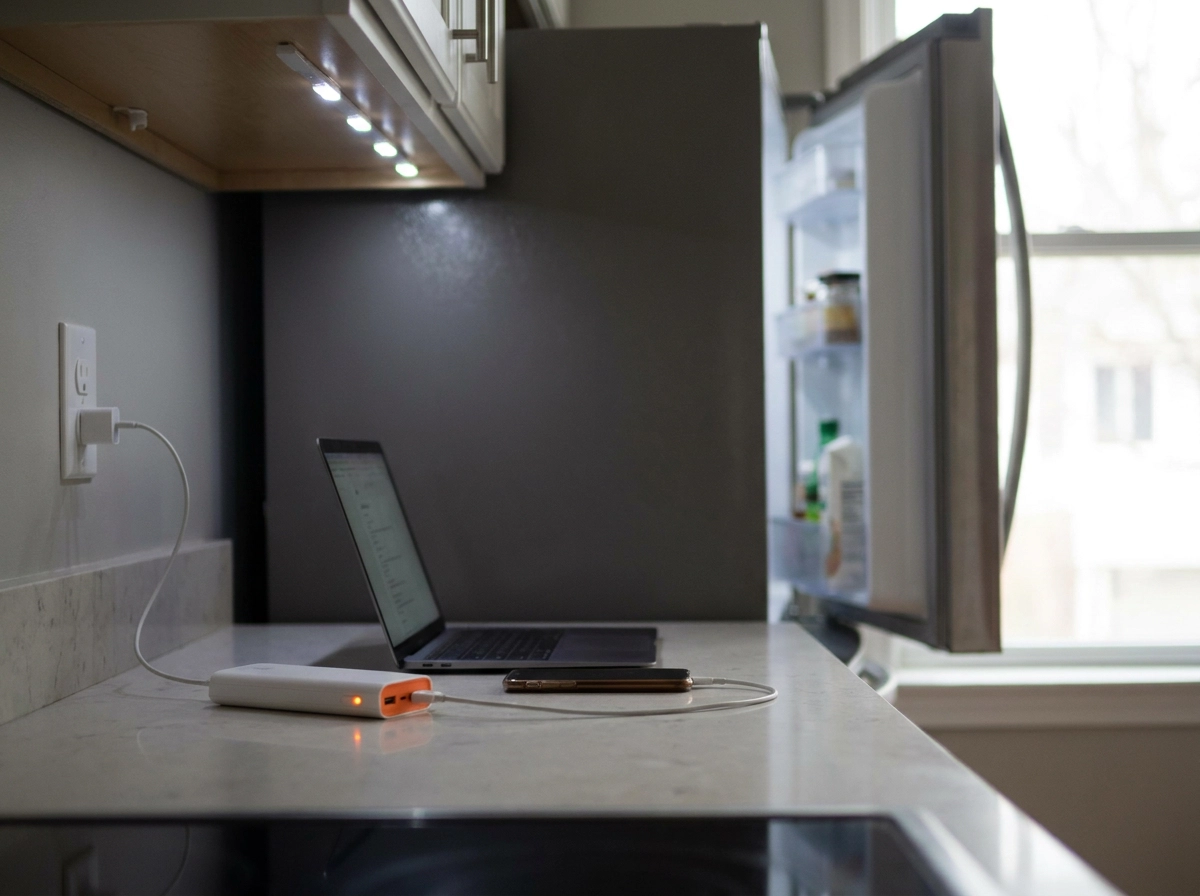
What a Home Battery Backup Typically Keeps Running
That list is shorter than most homeowners expect: residential backup systems carry a defined set of circuits, not the whole home. In a typical Kelowna or West Kelowna house, that often means the refrigerator, freezer, a few lighting circuits, the internet modem and router, phone and laptop charging, the garage door opener, the sump pump and a microwave.
Natural gas heating? The furnace blower is a common addition, and it matters in a January outage. Electric heat is different, and we cover it next.
Rural and acreage properties around Lake Country and Peachland often have well pumps, pressure tanks or septic pumps. They can usually be backed up, but their heavy startup surge means the battery and inverter must handle it.
Medical equipment is a frequent reason homeowners start looking at solar battery storage: a CPAP machine, oxygen concentrator or refrigerated medication.
A work-from-home setup matters too: modem, router, monitor and laptop are a light load, and many homeowners find backing those up matters more day to day than a bigger appliance they use once a week.
This is a starting point, not a promise. Your installer builds the real list after reviewing your panel and your priorities.
Ask how many circuits will move to the backup panel, and the expected runtime for each. Get it in writing before you sign.
A generously sized battery can be wired for whole-home backup. That costs more, so weigh the trade-off.
What a Battery Backup Will Not Run, and Why That Is Normal
Electric resistance heating, including baseboard heaters and electric furnaces, is one of the biggest loads in a BC home. Natural Resources Canada has estimated that space heating takes roughly 60% of an average Canadian home's energy use. A battery that runs your essentials for a day might run one electric heater for a couple of hours.
Central air conditioning and heat pumps are the other surprise. Compressors draw a large startup surge, and cooling a whole house through a summer outage is beyond a typical residential battery.
Electric water heaters, ranges, ovens and dryers are usually left off the backup panel. They drain stored energy quickly and leave nothing for the fridge, lights and internet. Level 2 EV charging will empty most home batteries in a short time, so many owners treat the EV charger as grid-only.
None of this is a shortcoming of the technology. This is the same maths every backup source faces; generators, batteries and portable units are all sized rather than installed. If you need one of these loads, the options are a bigger battery stack, a battery paired with a generator, or load management that staggers large appliances.
Watch for vague promises about whole-home backup. Ask what is wired to the backup panel, how many kilowatt hours of usable storage the battery provides, and what continuous output it can sustain. Setting honest expectations up front separates a delighted homeowner from a disappointed one.
How Backup Circuits, Subpanels and Sizing Set the Limits
Those limits start with two design choices. A critical load subpanel moves selected circuits into a smaller panel fed by the battery. A whole-home backup setup keeps your main panel and relies on equipment and load management rated for the full service. The critical load approach is more common and usually cheaper, and it is what most homeowners picture when they ask for the essentials to keep running.
Three numbers decide what you get: usable kilowatt hours of storage, continuous output in kilowatts, and short-duration surge capacity for motors starting up. All three have to be adequate, not just the first.
In principle the math is simple: add up what your backed-up circuits draw, then compare that to usable storage to estimate hours of runtime. A fridge and a few lights draw little; add a well pump and the picture changes.
Wiring happens once and is awkward to revisit: adding a circuit later means another electrical visit. Think your list through at the design stage.
Ask for a load calculation and a per-circuit runtime estimate. A reputable installer will produce one and explain its assumptions.
Under-sizing is the most common disappointment. If emergency heating, a well pump or a home office matters to you, say so during the assessment rather than discovering the gap in a February storm. Over-sizing has its own cost, so aim for a fit rather than the biggest battery on the quote sheet.
How Long Will a Battery Last During a BC Outage?
Once your installer has run the load calculation, the next question is simple: how many hours does that add up to? Runtime is a calculation, not a fixed number. Usable capacity divided by your average backed-up load is the basic formula, and every household lands somewhere different.
The biggest lever you control is what you switch on. Fewer circuits and conservative habits stretch stored energy. A fridge cycling normally uses far less than one left open by kids exploring a dark house.
Okanagan winter matters here. On a December or January outage, your array contributes modestly at best. That is why many systems keep the battery topped up from solar and the grid, so an outage finds you near full rather than half empty.
Multi-day outages do happen in rural BC. Riding one out usually takes a larger battery stack, daytime solar recharging, a generator, or a combination.
Ask your installer to spell out expected runtime for a short outage, a full day and a multi-day event, plus what would have to change in your habits to hit the longer figures.
What BC Hydro's Rebate Page Says About Solar and Battery Storage
Runtime is one question. Cost is another, and rebates usually enter the conversation right there.
BC Hydro's solar and battery rebate page says rebates are available for eligible solar panels and paired battery storage systems for customers who participate in the self-generation service. That is the short version. The page we reviewed did not set out amounts, eligibility criteria or deadlines, and incentive programs change. So confirm current details on BC Hydro's live rebate page, and on the self-generation overview and how-to-apply pages, before you budget around any figure.
One useful takeaway: BC Hydro appears to treat storage as part of a paired package rather than a standalone purchase. That is worth understanding, because participating in the self-generation service comes with its own requirements.
We never quote rebate amounts, eligibility or timelines, and you should be sceptical of anyone who does without pointing you to the live utility page. If a rebate is part of your decision, raise it with your installer early so the paperwork and the system design line up with whatever the program currently requires. Local conditions add another layer, which we will get into next.
Planning Backup in Kelowna, West Kelowna and Across the Okanagan
Once you know where rebates stand, the next question is local: what does your household actually need when the grid goes down?
BC Hydro's territory includes heavily treed, rural and mountainous areas, where windstorms, winter weather and wildfire-related interruptions shape what you want a solar-plus-battery backup to carry.
If your property is on a well or septic pump, water delivery and waste removal depend on electricity, so those loads need real thought. Municipal water eases that concern.
Heating matters just as much. A gas furnace blower is a modest load worth backing up. Electric baseboard heating is a different animal, and knowing which one you have changes the whole conversation.
This is where a local conversation helps. We are based in Kelowna and work with our qualified installation partner, Energy Economics, to help homeowners understand their needs and assess options. We serve Kelowna, West Kelowna, Lake Country, Peachland and the Central Okanagan, plus the broader Okanagan, the Lower Mainland and other parts of BC.
A general article cannot tell you which circuits in your panel are realistic candidates, how your roof and shading affect solar production, or what your household truly needs during an outage. There is no cost or obligation to ask, and no pressure attached.
The Short Answer: What Solar Plus Battery Backup Will Run
Solar panels alone keep nothing running in a BC Hydro outage, and that is by design. Grid-tied inverters must stop producing when the grid goes down, so it takes a battery to turn your array into backup power.
A properly configured home battery typically carries selected circuits: refrigeration, lighting, internet, phone charging, and often a furnace blower, well pump or medical device.
It will not run electric heating, central air conditioning, an electric water heater, an electric range, a dryer or EV charging, unless you deliberately size and wire for them.
Before you buy, get three things in writing:
The list of backed-up circuits
A load calculation with expected runtime
Confirmation of which equipment supports backup or islanding mode
Then check BC Hydro's live rebate and self-generation pages, because program details and requirements change.
Want to know what your own home could keep running? Request a no-obligation local solar consultation at westwindsholdings.ca/solar, and bring your electrical panel photo and your list of must-haves.
Conclusion
Solar panels alone won't power your home during a BC Hydro outage; a battery is what turns your array into backup power. A well-designed system usually keeps selected essentials running, such as refrigeration, lights, internet, phone charging, and sometimes a furnace blower, well pump or medical device. Larger loads like electric heat, air conditioning, water heating, ranges, dryers and EV charging normally stay off unless you plan and size for them. Backup circuits, subpanel choices and load calculations set those limits, and runtime depends on your battery size and how carefully you use power.
The best next step is a local, no-pressure review. Gather your electrical panel photo and your list of must-haves, then request a no-obligation consultation at westwindsholdings.ca/solar to see what your home could realistically keep running.